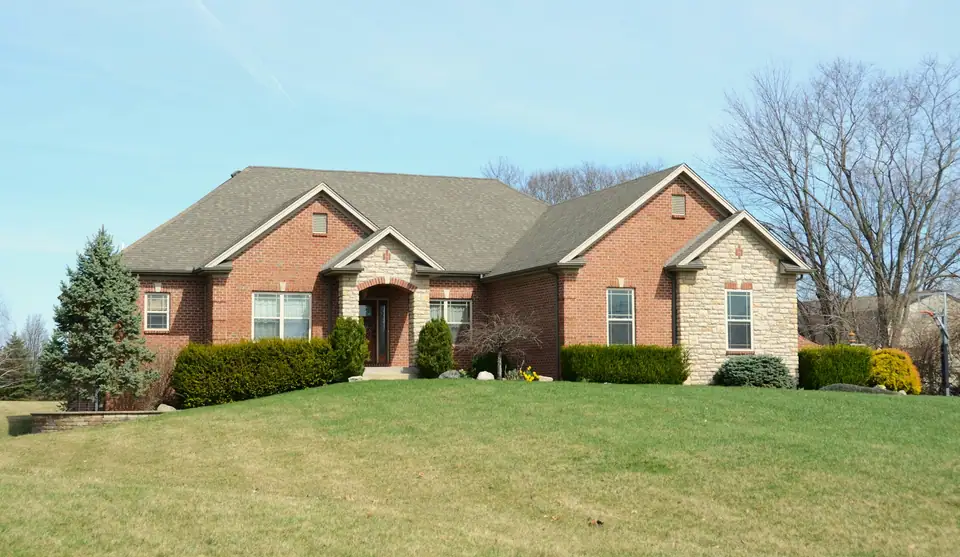
Clearwater sits in the southwest corner of Sedgwick County along K-42, surrounded by farmland. Alongside newer homes in town, the area has a lot of older houses: farmhouses that have been added onto over the decades, homes with small cellars under one room, and porches enclosed to become living space. Each change can mean another type of foundation under the same roof.
One house, three foundations
A typical example: an original section with a partial basement or a cellar, a 1970s addition on a slab, and a back room over a crawl space. Radon can enter through all three. A system designed for only the basement may leave the slab addition or the crawl space untreated. When an installer looks at an older Clearwater house, expect them to walk every section and explain how each one will be handled:
- Basement or cellar with a concrete floor: sub-slab suction, plus sealing cracks and the floor-wall joint.
- Slab addition: possibly its own suction point if the slabs aren't connected underneath.
- Crawl space: a heavy plastic membrane sealed over the soil, with suction underneath (sub-membrane depressurization).
Dirt-floor and stone cellars
Some older homes have a cellar with a dirt floor or a thin, broken concrete floor, and stone or brick walls. Those let soil gas in easily. A dirt-floor cellar is usually treated like a crawl space: a sealed membrane over the floor with suction beneath it. If the cellar is used for storage, the membrane can be protected with a walkable layer. A thin or broken floor may be sealed and covered rather than replaced; your installer can explain the options and cost.
Old houses, drafty houses
It's tempting to think a drafty old farmhouse can't hold radon. In practice, warm air rising and leaking out of the top of a house in winter pulls soil gas in at the bottom, a "stack effect" that can make winter readings higher. Draftiness is no guarantee of low radon. Only a test tells you.
Testing tips for older homes
- Test the lowest room you use regularly, not the cellar if nobody spends time there.
- If the house has separate sections on different foundations, consider a kit in each lived-in section.
- Close windows and doors for 12 hours before and during a short-term test.
Getting a quote
Older homes with several foundation types tend to cost more than a simple basement system, because of extra suction points, membrane work and sealing. See the cost guide for typical ranges. Kansas law requires KDHE certification for anyone who mitigates for you. Tell us your ZIP code and describe each part of the house, and one certified professional who covers Clearwater will follow up.
Clearwater's radon test data
Clearwater's ZIP code, 67026, is in the top band on the 2019 KDHE and K-State map, averaging 4.0 pCi/L or more, as are Viola and Milton nearby. In an old farmhouse with a cellar and additions, test the lowest room you actually use. See our radon levels by ZIP code tool for the area, and our main Wichita radon mitigation guide.
Common questions
Can a radon system handle a dirt-floor cellar?
Yes. The usual approach is a sealed plastic membrane over the dirt with suction underneath, tied into the radon fan. It works the same way as a crawl space system.
Is an old farmhouse more likely to have radon?
Age alone does not predict radon. Older homes often have more openings to the soil, but newer, tighter homes can trap radon too. Test either way.
Will a radon system help with a damp cellar smell?
Sometimes a little, since the membrane and suction reduce soil moisture entering. It is not a substitute for fixing drainage or water problems.