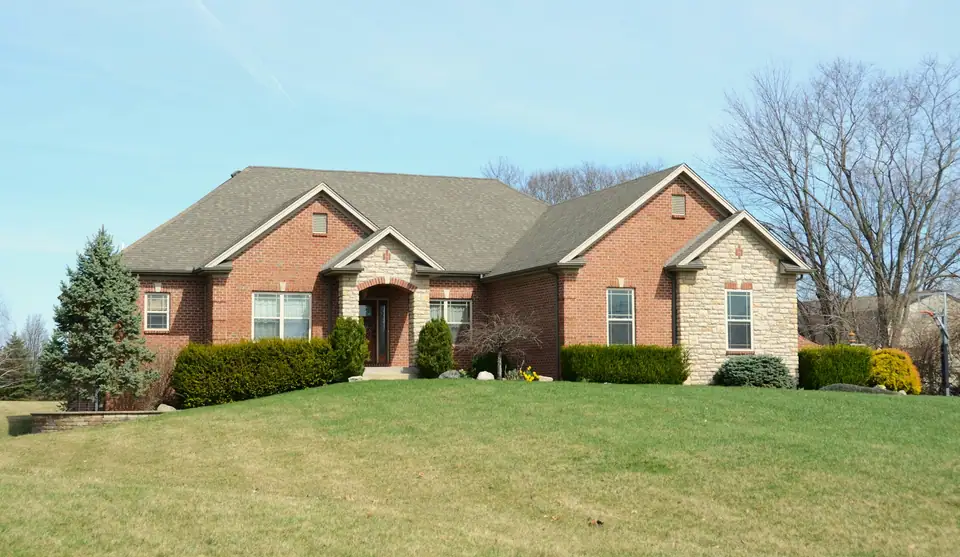
Haysville is directly south of Wichita, between Wichita and the county's southern towns. It has a large share of established single-story ranch homes, some on slab-on-grade foundations, some with partial basements, and some with additions on a different foundation from the original house. Each of those affects how a radon system is designed.
"I don't have a basement. Can I still have radon?"
Yes. This is one of the most common misunderstandings. Radon comes up from the soil through any contact between the house and the ground: cracks in a slab, the joint where slab meets wall, plumbing penetrations and floor drains. A slab home can test high, and the only way to know is to test. Put a short-term test kit in a main living area on the ground floor, at least 20 inches above the floor and away from exterior doors, windows and vents.
How a system works on a slab
The fix for a slab home is the same principle as for a basement: sub-slab depressurization. The installer drills a hole through the slab, removes a small pit of soil underneath, and connects a PVC pipe to a fan that pulls soil gas from under the house and vents it above the roof.
In ranch homes, the suction point is often placed in the attached garage, so the pipe can rise inside the garage and out through the roof without passing through living space. Other spots are a utility closet or laundry room. If the slab sits on clay or compacted fill rather than gravel, the installer may test airflow under the slab first and add a second suction point if needed.
Additions and mixed foundations
If your home has a family-room addition, an enclosed porch or a converted garage, it may sit on its own slab or over a crawl space that isn't connected underneath to the main house. One suction point may not reach it. Mention any additions when you ask for a quote so the installer can plan for it rather than discover it on install day. Mixed foundations are one of the main reasons quotes vary; see the cost guide.
Sealing helps, but isn't a fix on its own
Sealing cracks and gaps in a slab makes a system work better, and installers usually seal what they can reach. But the EPA does not recommend sealing alone as a radon fix, because it rarely lowers levels enough or for long. Treat sealing as part of a system, not instead of one.
Who can do the work
Any installer must hold KDHE radon mitigation certification. Ask for the certification number and check it on the Kansas Radon Program's list. Our guide to choosing a radon contractor lists the other questions worth asking.
Request a quote with your ZIP code and foundation type, and a KDHE-certified professional who covers Haysville will contact you.
Common questions
Where would the pipe go on my Haysville ranch house?
Common choices are the attached garage, a utility closet, or an outside wall. The garage route is popular because it keeps the pipe out of living space and the fan sits in the garage attic or outside.
Is radon mitigation cheaper on a slab than a basement?
Often the price is similar. What changes the price most is what is under the slab, how many suction points are needed, and the pipe route, not whether it is a slab or a basement.
My test is 3 pCi/L. Should I fix it?
The EPA action level is 4 pCi/L, and the EPA suggests considering a fix between 2 and 4 pCi/L because there is no known safe level. A long-term test gives a better picture of your year-round average before you decide.