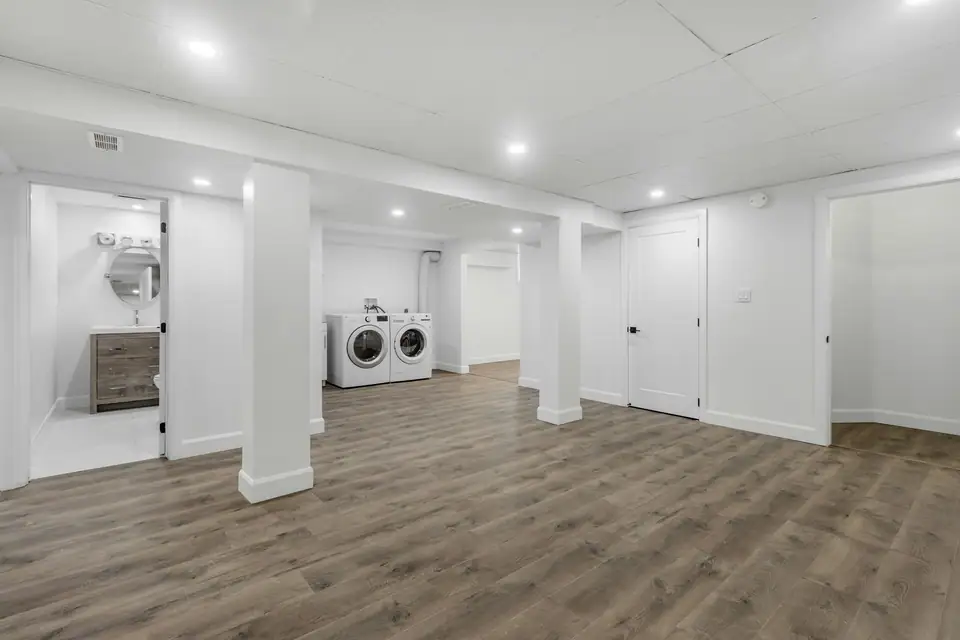
Maize, on Wichita's northwest side, has grown quickly, with newer subdivisions full of family homes. A lot of them have full or walkout basements finished as kids' bedrooms, playrooms and home theaters. Since radon tends to be highest at the lowest level, and children may spend many hours sleeping down there, it's worth knowing your number.
When to test a new Maize home
You can test any time, but a few tips help:
- Test after you've moved in and are living normally, with heating or air conditioning running. A newly built home that's been open for construction traffic won't give a typical result.
- Cold months often give higher readings because the house is closed up and warm air rising draws more soil gas in. A short-term test in winter gives a conservative result.
- For the best picture of what your family breathes over a year, follow up with a long-term test of more than 90 days.
Sump pits and drain tile
Many newer basements have a sump pit connected to drain tile around the foundation. An open or loosely covered sump is a direct path for soil gas into the basement. A mitigation system normally includes an airtight, clear-view sump lid so you can still see the pump. In some homes the installer can draw suction from the sump and drain tile itself, which spreads the vacuum around the whole basement. The pump keeps working normally.
Walkout basements
A walkout basement is partly below ground and partly at grade, with a full-height wall and door on one side. It still sits on soil and can still have high radon. The suction point usually goes in an unfinished storage or mechanical room, and the pipe can exit through the rim joist and run up the outside, or go up through the garage. The walkout side often makes an exterior route easy to hide.
What it costs
For a typical Maize basement home with one suction point, our estimate of the usual installed range is about $800 to $1,500, with interior routes and extra suction points costing more. See the cost guide for what changes the price. Your written quote is what counts.
Next step
If you haven't tested, start there; our guide to test results explains what the numbers mean. If you already have a result of 4 pCi/L or higher, send a quote request with your ZIP code and a KDHE-certified professional who serves Maize will follow up.
Common questions
Is it safe for kids to sleep in a basement bedroom?
Test and find out. If the basement level is below 4 pCi/L, the EPA does not recommend action, though lower is always better. If it is 4 or higher, a mitigation system typically brings it well down. Retest after installation.
Will a radon system affect my sump pump?
No. The sump gets a sealed lid, often with a clear window, and the pump runs as before. Some systems use the sump and drain tile to spread suction, which can make the system more effective.
Did my builder already handle radon?
Some builders install a passive pipe; many do not. Look for a labeled PVC pipe coming out of the basement floor. Either way, a test is the only way to know your level.